The chips stay
on the table.
Tables, waiting lists, buy-ins, cash-outs and seat fees in the same program as your tournaments. The room handles the cards. FeltTD keeps the records.
A cash room beside
the tournament.
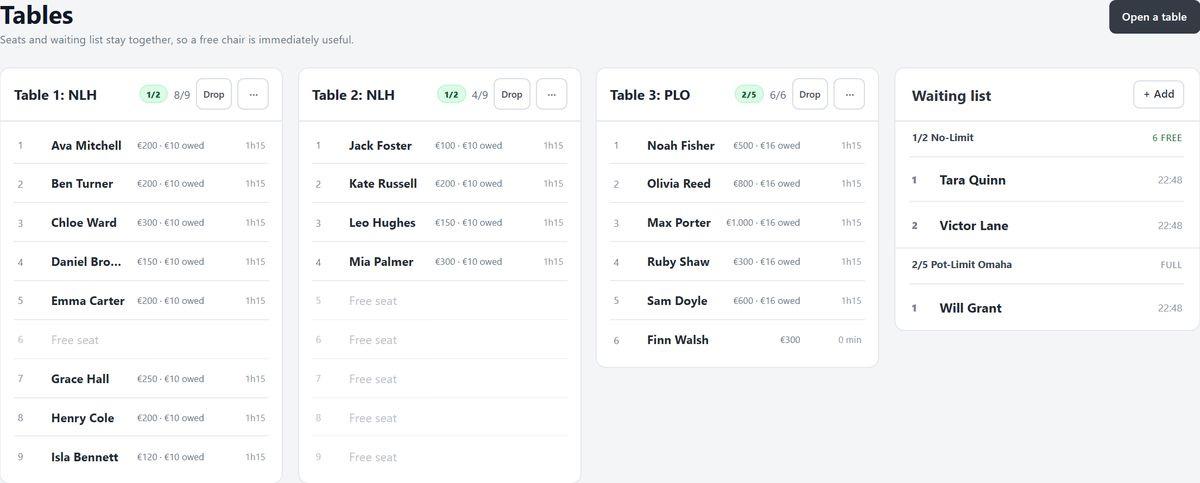
Set up the games, stakes, buy-in limits and fees. Open tables and see who sits where. The cash room has its own workflow and never uses one of the tournament slots.
- More than one game. Keep each game’s tables and waiting list together.
- A clear seat view. Player, time seated, money in and fees owed.
- Your floor’s decision. Open, close or adjust a table as the room changes.
Keep the queue
moving.
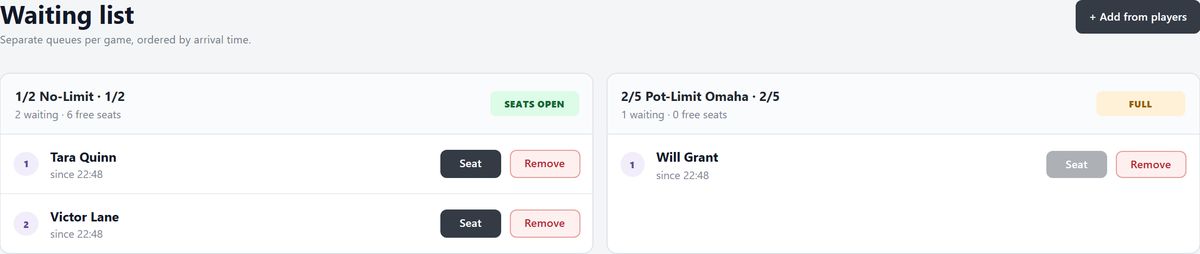
Seat a walk-in or add them to the waiting list for their game. When a seat is free, call the next player. The board tells the room where to go; you confirm the seat when they arrive.
- In arrival order. A separate waiting list for each game.
- Checked buy-ins. Respect the game’s minimum and maximum.
- A board for the room. Show tables, games or the waiting list on the TV.
In. Out. Owed.
In one place.
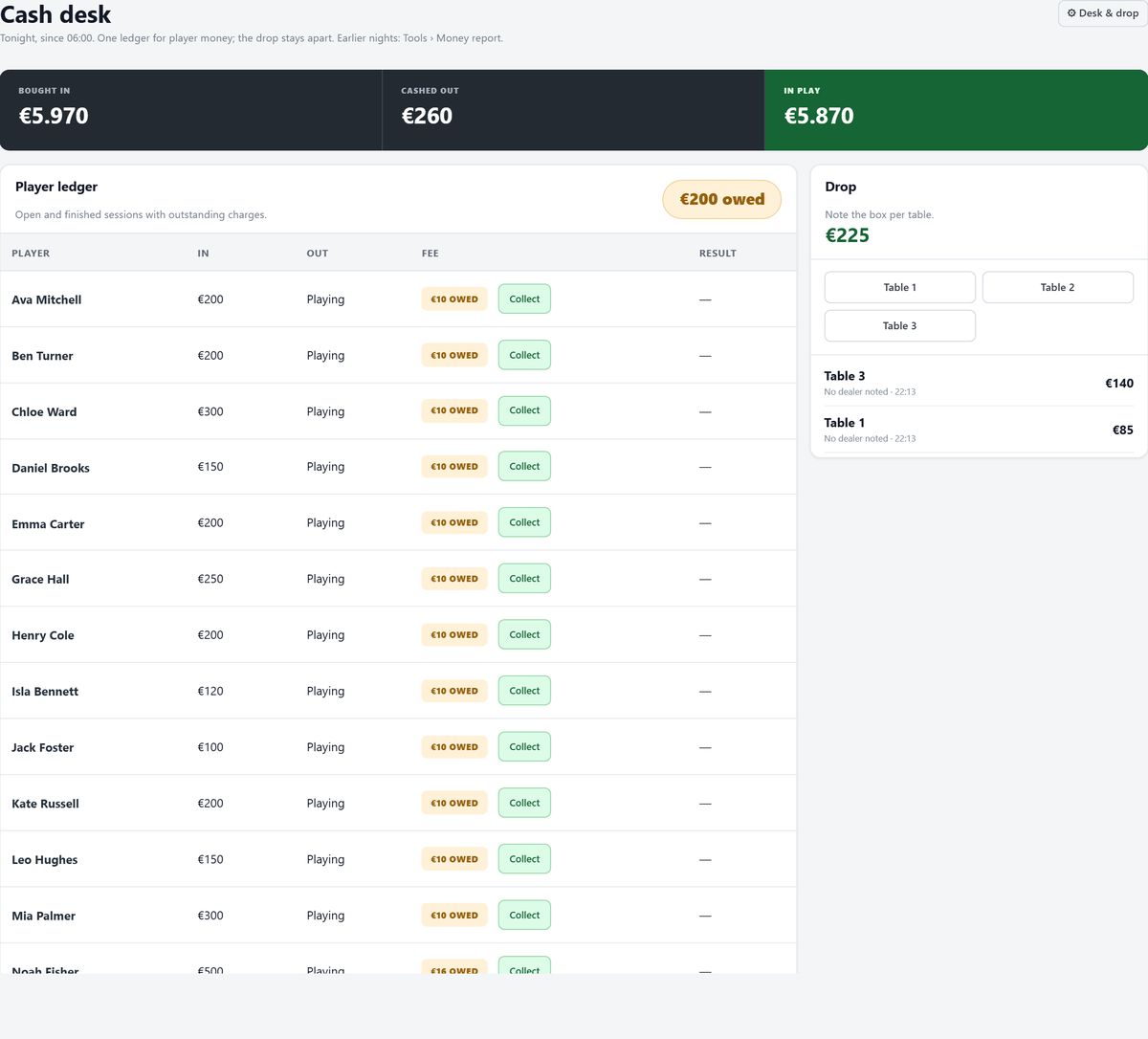
Record buy-ins and top-ups, collect seat fees, and cash the player out. The ledger keeps the session together. An unpaid balance from an earlier night stays visible until collected or waived.
- Time and session fees. Collect what is due, including a balance left by a short stack.
- Drop per table. Record the amount, and the dealer if you choose.
- Waived is not paid. Write-offs stay separate from money received.
The details, when you need them.
Open a topic. Keep the rest out of the way.
Your games, your fees, as many tables as the room holds.
A game has a name, stakes and a type, seats per table, a minimum and maximum buy-in, and its seat fee: an amount per period of so many minutes, free minutes before it starts, and or a fee on sitting down. Open tables per game; a seat over or under the game’s number is a floor decision, not a rule.
- Every seat shows the player, money in, what is owed and the seat time.
- Collected payments stay recorded against their player session.
- The cash room is always there, in the switcher beside the tournaments, and never takes one of their five slots.
Walk-ins, one after another. A waiting list per game.
F2 seats instead of registering: pick the player, the game and the buy-in, and seat now at the first free seat or put them on the waiting list. The list runs in order of arrival; click a name and only that game’s seats light up; drag a queued player into a seat. Call the next player and the TV says “Anna, table 2, seat 5” for two minutes. Calling never seats: people walk.
- Buy-ins are checked against the game’s minimum and maximum.
- Moving is a seat change, never a game change.
- Re-seat from the waiting list with one tap when a seat opens.
In, top-ups, seat time, out. One ledger per player.
Top up at any time. The seat fee is charged per started period, after the free minutes, and Collect takes what is owed now. Cash out: type what the player takes away, and what is still owed is paid at the desk or taken off the stack. A stack too small for the seat time pays what it has; the rest stays on the desk to collect, or to waive. FeltTD shows the player’s result: what went out minus what came in.
- Undo covers seating, top-ups, fees, cash-outs, the drop and the waiting list.
- A night runs from six in the morning to six the next, so a game past midnight stays one night.
- The software never claims to know a stack. Chips are the table’s business.
What the box should hold.
Bought in, cashed out, in play. The ledger per player session: in, out, fee, result. The drop per table, with the dealer’s name if the club wants it, and the totals per dealer. FeltTD does not calculate rake; it records what the box held. A seat fee still owed from an earlier night stays in the ledger with its night until it is collected or waived.
- Collect or Waive right on the desk. A waived fee is reported apart, never as money.
- The money report books the cash room per day beside the tournaments: seat fees and drop, what the club kept.
- Closing FeltTD cashes nobody out; seat time keeps running.
What the software does not know
The chips move between players at the table. FeltTD records the money you enter; it does not track live chip stacks or calculate the table’s rake for you. Record the drop you actually counted.
One set of books for the club.
See the cash room alongside your tournament fees in the money report.