Built around
a working floor.
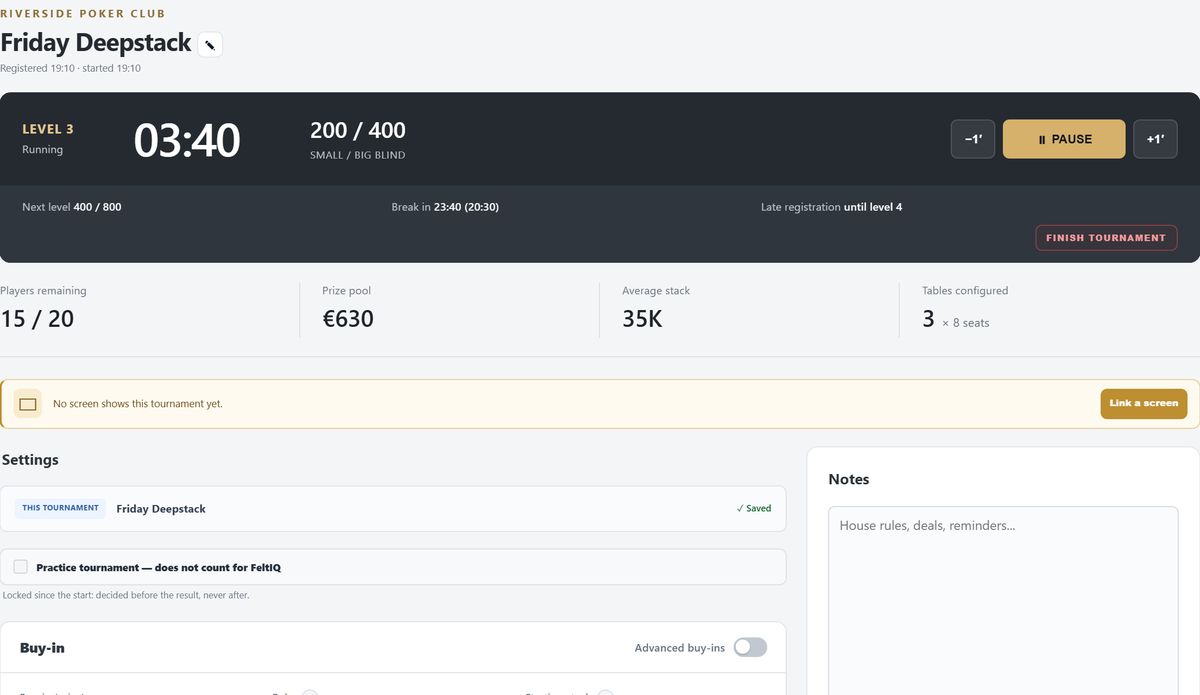
The real test is a busy club night: players at the door, a table to break, a wrong bust to take back. FeltTD brings those jobs into one familiar place.
Run the night.
Internet or not.
The manager runs on the host PC. The TV and floor devices join locally. Your tournament does not rely on an internet connection; optional club publishing and online voice creation are separate.
- One host. Screens and floor phones share its tournament.
- Local player records. Personal details stay on the tournament PC.
- A practical setup. Windows or Mac, HDMI and the network you already use.
A wrong bust
is a fixable bust.
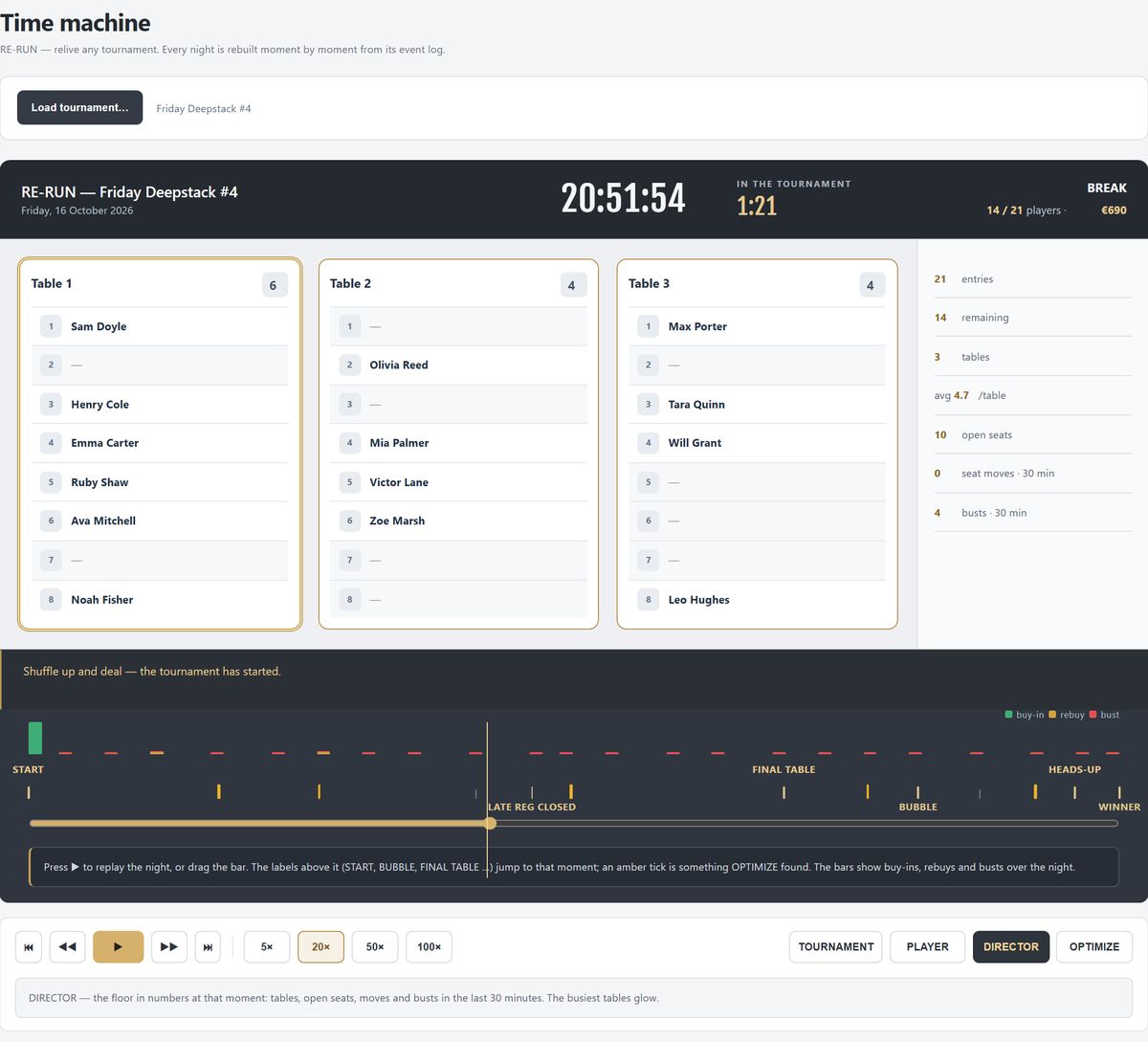
An action goes into the night’s log. The figures follow that record. Undo a mistake, review a moment in the time machine or restore a saved point with a rescue copy first.
- Undo close to hand. The last action is in the top bar.
- A record to inspect. See who acted and when.
- A second copy matters. A recovery folder on another disk helps protect against hardware loss.
The small decisions add up.
The floor can work
A phone handles the actions at the table. A tablet can be a second desk. No install is needed for the floor browser.
The regular night stays familiar
Save the setup, structure and payout model. Next week, start from what the club already knows.
The details stay available
Multi-day events, satellites, bounties, cash and the books are there when the club needs more.
The details, when you need them.
Open a topic. Keep the rest out of the way.
Undo, replay and recovery
FeltTD never stores a position or a pot. It stores what happened: a line per action in the night’s log, written a second after each one. Everything you see is calculated from that log. Undo a wrong bust and every position fixes itself, because positions were never written down in the first place. After a restart, FeltTD can continue from the actions saved in its log. A recovery copy on another device protects against losing the original disk.
- Undo anything, from any device, up to three actions back; FeltTD refuses to undo someone else’s work in between.
- Restore a moment: rewind the live night to any point, with a rescue copy written first.
- A live mirror to a USB stick or a cloud folder, and a plain file per night that is yours.
Working on the club’s own network
One PC runs FeltTD. The TV hangs on it, the phones and screens join over the club’s own Wi-Fi. No account, no login, no cloud, nothing that can be down at nine on a Friday. Making a voice line needs internet once; playing it never does. The only thing that needs the internet is your club page, and that is a switch.
- Windows and Mac. A real installer; the club’s own files stay at an update.
- Two languages, English and Dutch, the manager in one and the room in the other.
- Old PCs stay fast. No animations that cost, no frameworks that break.
The floor is in the hand.
A phone is the floor app: scan a QR, no install. Floor staff bust, rebuy, move players and count chips at the table. A tablet gets its own layout and becomes a second desk. A second FeltTD across the room can join one tournament on the host, as a registration desk. Every action carries the name of the device that did it.
- Floor or full TD, approved once on the PC; settings behind a four-digit code that changes every tournament.
- Screens never ask. They only watch.
It watches the tables, and it speaks.
Uneven tables, a table that can be broken, the bubble: FeltTD sees it and offers the move, the break, the hand-for-hand. The break planner draws new seats as a suggestion you adjust before the TV shows them. An announcer speaks at the moments of the night, sounds never talk over each other, and the bigger moment always wins the microphone.
- Seating rules as warnings in amber, never as blocks: you are the TD.
- Table Talk: facts from the club’s own history on the screen during breaks.
- Your own voice lines, made once, played offline.
Money that adds up. Always.
The prize table follows the field and always adds up to the pool to the cent. Rake and bounties are never in the pool; unpaid registrations never count. A price changed after people paid asks what to do with the old deals. ICM and chip chop sit side by side for a final-table deal. The money report tells the treasurer what the club kept, per night and per period, and the cash desk knows what the box should hold.
- A print sheet with a signature line per place, marked final or provisional.
- A practice night is listed, labelled, and counted in no total.
It learns your club.
ClubIQ rates the strength of the field from results only. FeltIQ follows each player, with an honest margin. The time machine replays any night and marks the floor out of ten: tables left uneven, breaks made late, players kept waiting. Import your old software’s history and the ranking, the database and ClubIQ start full on the first night.
Cash games in the same program.
A cash room beside the tournaments, always there: games with seat fees, tables, a waiting list per game, buy-ins, top-ups and cash-outs, the drop, and a desk. The cash board on the TV. A cash night never touches the ranking or the ratings; it is money, not results.
Your club online, without your players online.
Link the PC once and the club has a page on FeltTD.com and a live widget for its own website: the clock, the next game, recent results, ClubIQ. Only what you switched on leaves the PC. Winners appear as “James W.” or with no names. Player lists, stacks and payments never leave the room, and a practice night never appears.
Privacy in the room and online
Floor phones and room screens receive names, not the club’s private contact fields. Online club pages publish the figures the club enables. Winners can use a first name and initial, or no name. Practice tournaments are excluded. Optional live-data feeds have their own privacy settings.
See whether it fits your club.
Start with your regular night, your own structure and your real workflow.